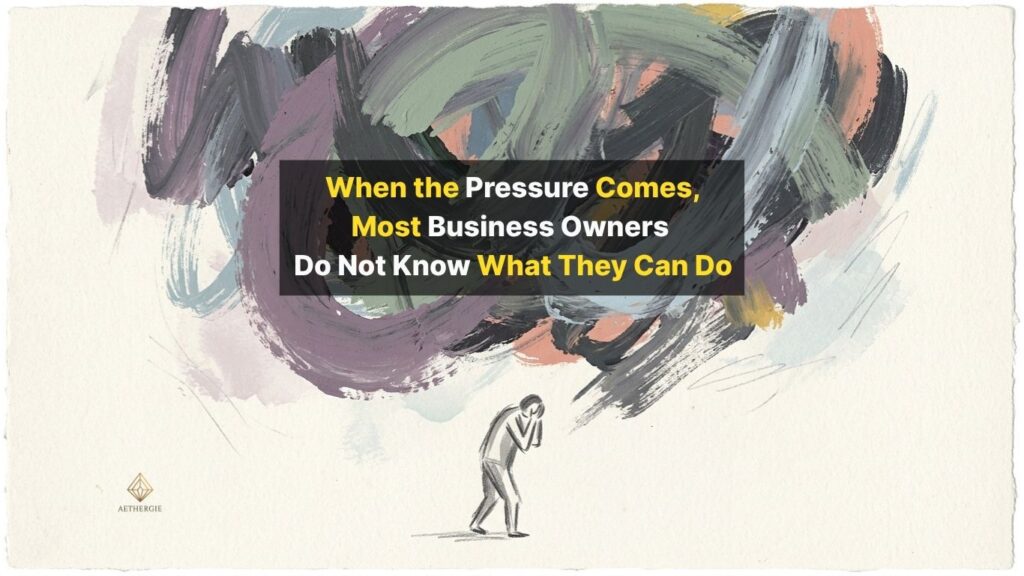
When the Pressure Comes, Most Business Owners Do Not Know What They Can Do
There is a particular kind of silence that falls over a business owner when things start going wrong. The calls from suppliers getting shorter. The payment terms getting tighter. The inbox filling up with things they keep pushing to tomorrow.
Most prefer not talk about it…until it’s too late. Not to their accountant, not to their lawyer, not even to their business partner. Because talking about it makes it real. And if it is real, something has to be done about it.
But here is the thing. The options available at that point, the ones that could actually change the outcome, are widest when the pressure is just starting. Not when a statutory demand has arrived. Not after a creditor has filed legal action. Before.
Time is the one resource that cannot be recovered. And in business distress, it spends faster than cash.
This piece is not about war stories or cautionary tales. It is about knowing. Because the single biggest gap most business owners carry is not a cash flow gap. It is a knowledge gap.
The Two Sides of Business Distress
Every distress situation sits on one of two sides of the table. Either your business owes money and the pressure is coming from creditors, lenders, or suppliers. Or someone owes your business money and you are the one waiting, chasing, absorbing the shortfall.
In both cases, time passes. And in both cases, the options narrow the longer the situation sits unaddressed.
What changes between the two situations is the tools available and how aggressive you need to be.
If Your Business Is the One Under Pressure
The first question to answer is not how to pay everyone. It is whether the business itself is fundamentally viable. Because the answer to that question determines everything that follows.
A business that has a sound model, real customers, and genuine demand for what it does but is drowning in legacy debt or a cash timing problem is a very different situation from one where the model itself no longer works.
The first can be restructured. The second cannot be saved by restructuring alone.
When Restructuring Is Still Possible
If the core is viable, there are options that preserve the business and keep the owner in the driver seat.
Negotiating directly with creditors for extended terms or a partial settlement costs nothing to attempt and is often the fastest path.
A Company Voluntary Arrangement (“CVA”) formalises that process with legal protection. Judicial Management (“JM”) hands over control to a court-appointed manager but puts a moratorium on creditor action while a rescue plan is developed.
None of these are easy. But all of them are better than the alternative.
When Liquidation Is the Reality
When the business cannot be saved, the choice is not whether to close but how.
A voluntary winding up where the company initiates the process is a completely different experience from a compulsory winding up where a creditor petitions the court.
In the voluntary path, directors initiate the winding up. Private Liquidator appointed and assets are distributed in proper order. The outcome is managed rather than imposed.
In the compulsory path, control is gone the moment the Order is made. The Official Receiver/Private Liquidator steps in. Affairs of the Company is investigated. It is not a place any business owner chooses to be.
If Someone Owes Your Business Money
On this side of the table, the mistake is patience without strategy. Waiting and hoping a customer will pay is not a plan. It is a slow bleed.
The tools available range from a formal demand letter through to a statutory demand that legally presumes insolvency if ignored. From there, a winding up petition against the debtor company is a real option for undisputed debts above a threshold.
But the approach changes depending on whether the debtor simply will not pay or genuinely cannot. If a key customer is in distress and their survival matters to your revenue, you may have more value in supporting their restructuring than forcing their closure.
The decision requires judgment, not just aggression.
Know Before You Need To
The business owners who navigate these situations best are not always the ones with the most cash or the best lawyers. They are the ones who understood their options before the pressure arrived.
They knew what a CVA actually meant. They knew what a statutory demand triggers. They knew at what point a creditor could force a winding up. These knowledge meant they were not making decisions in a fog.
Knowing your options is not pessimism. It is what leadership looks like when the stakes are real.
We have built an interactive tool that walks through every recovery option across both sides of the table.
Debtors, creditors, restructuring paths, liquidation types, and everything in between.
Clear, structured, and built for business owners who need to understand the landscape before deciding anything.

Aethergie specialises in restructuring, insolvency, and business advisory services, helping businesses navigate financial challenges and build sustainable growth strategies.
Get in touch with us for more info.
Time Waits for No One.
Find this helpful?
Join the Aethergie Vault for more freebies, tools, and insights — and follow us to stay updated.